Standard Wing

Extended Wing

Pinewood Derby Times
Volume 12, Issue 5
November 28, 2012

In this Edition:

- Editor's Notes

- Feature Article - Shop Talk: Hand Sanding

- Humor

- Product Showcase - Sandpaper Holder

- Pinewood Derby Car Showcase

- Q&A


Editor's Notes

New Product
Flat Tundra
Maximum Velocity now offers Tundra (tungsten composite) in both cylindrical rod and flat format. Both of these products replicate lead in both size and density, but without side effects. You can substitute Tundra Rod for Lead Wire and Flat Tundra for Segmented Lead. You can read more and order Here

MV Basic & Wedge Car Kits

If you are planning a race and are not required to use a specific kit type, our MV Basic or Wedge Car Kit are just what you need. These attractively priced kits are equipped with:
  • Quality Block - Unlike the blocks provided by some organizations, our blocks are soft, northwestern pine blocks, cut precisely to 7 inches long, 1-3/4 inches wide, and 1-1/4 inches tall. These dimensions, as well as the axle slots accurately duplicate the dimensions of standard pinewood derby blocks from BSA and PineCar.

  • Simple Axle Preparation - Don't worry about filing off flaws, or losing hub caps. Our Speed Axles have no burrs or crimp marks, and install without hub caps. With or without polishing, they are ready to go. We supply five, so you have a spare.

  • Quality Wheels - Forget cheap, out of round wheels. Our MV wheels are top-quality wheels. You will not be disappointed with the quality of these wheels.

So, if your organization does not mandate a particular kit type, consider our MV Basic Car Kits or MV Wedge Car Kits.

Inventory Clearance Sale
We are clearing inventory on several items including car kits, car plan booklets, and pine blocks (plain, standard, and extended drilled). Click Here to find our clearance items. Don't miss out on the great prices.

Can We Help?
If we can help you in any way with your pinewood derby project, or if you have any feedback regarding this newsletter, please contact us at: [email protected]


Feature Article

Shop Talk: Hand Sanding
By Randy Davis

If you want a sharp looking pinewood derby car, then proper sanding is critical. Choosing correct grits of paper, selecting the right sanding accessories, and applying the proper techniques are all necessary for getting a silky smooth block that is ready for painting. Let's take a look at each of these areas in turn.

SANDPAPER TYPES AND GRIT
For wood sanding "garnet" and "aluminum oxide" papers are the most commonly used. Garnet paper (brownish-red color) provides a slightly better finish, but it wears out quickly. Aluminum oxide paper (generally silver gray, but can be other colors) lasts much longer, but doesn't provide quite as nice of a finish. One technique is to use aluminum oxide paper for the coarser sanding, and then use garnet paper for the final sanding.

Another type of paper is "silicon carbide". This type of paper can be used wet or dry, and is generally used for sanding between coats of primer/paint.

Sandpaper coarseness is rated by "grit", with lower numbers indicating coarser paper. Generally, a coarse paper is used for initial shaping and removing saw marks. Then finer papers are used to remove the marks left by the coarser paper. A common grit progression for pinewood derby work is: 60, 100, 150, and 220.(1) A quicker progression is 60, 120 and 220. Generally, after 220 grit paper, car bodies can be primed. However, some people like to go a step further and use 400 grit paper before painting.

SANDING ACCESSORIES
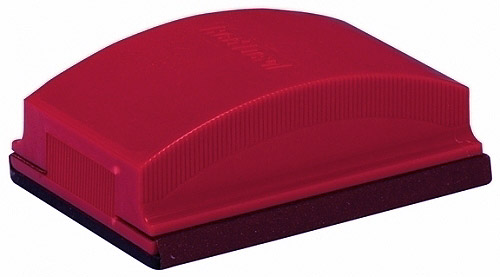
Sanding is easiest and most effective when the sandpaper is held in a sandpaper holder or wrapped around a piece of wood. For sanding flat and outward curving surfaces, a padded sandpaper holder(2) is the way to go (see Figure 1). This holder is designed to securely hold one- quarter of a sheet of sandpaper. The padded surface improves the smoothness of the finish, especially with finer papers.


Figure 1 - Padded Sandpaper Holder

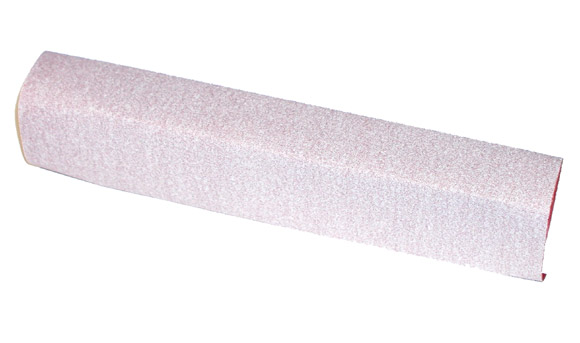
For initial shaping with coarser papers, if you need to ensure the flatness of a surface, then you can wrap sandpaper around a block of wood such as a pinewood derby block (see Figure 2). Use a standard stapler to fasten the paper to the block on one side - just don't sand on the side with the staples! Once you have achieved the desired flatness, switch to a padded sandpaper holder.


Figure 2 - Sandpaper Around Block

Another handy sanding tool is a large diameter dowel rod. By wrapping paper around the dowel rod, inward curves can be readily shaped and smoothed. If you don't have a dowel rod, then wrap some sandpaper around your index finger.

SANDING TECHNIQUES
First, before any discussion of technique, make sure to wear a particle mask and safety glasses when sanding. Filling your nose, lungs, and eyes with wood dust is no fun, and certainly not healthy. I have also found that sanding in the open air where there is a little breeze will greatly reduce the cloud of dust that tends to hover around.

Stroke
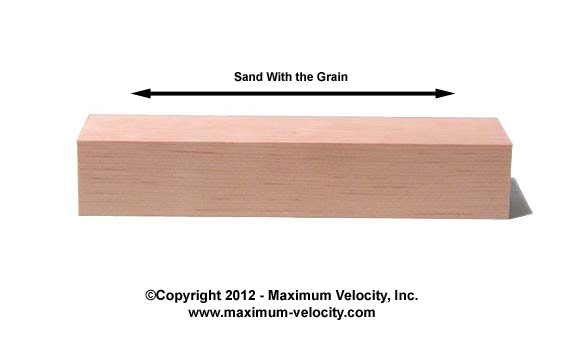
When sanding car bodies, where at all possible sand with the grain of the wood. This provides the best finish with the least amount of work. On the end of the block (such as the back of the car body), you can sand in any direction. But I have found that a circular motion works best.


Figure 3 - Sanding Direction

Progression
Start with the coarser paper, making sure to achieve the desired shape and eliminate saw marks. Wipe or blow off the dust so that the surface can be inspected. If marks still exist, sand some more. Parents, you can help your children know how much to sand by marking flawed areas with a pencil. Then tell them to sand off the pencil marks.

When ready, switch to the next finer paper. Sand until all marks from the coarser paper are eliminated. Make sure to wipe off the dust and inspect carefully. Then continue the process until the last paper is completed.

One final step before painting is to "ease the edges". This is done by taking 220 grit sandpaper or a sanding sponge(3) and sanding all edges of the car to eliminate the sharpness. Easing the edges gives the car body a nicer feel, but mostly it improves the final finish as it allows the paint to bind better to the edges of the car body.

1Maximum Velocity offers a Sandpaper Assortment containing 100, 150, and 220 grit papers. Our pre-cut car bodies have already been sanded with 60 grit paper.

2You can find a padded sandpaper holder Here

3Sanding sponges can be found Here


Humor

There are many stories related to the sinking of the "Titanic." Some came to light when the Titanic movie was released.

For example, most people don't know that back in 1912, Hellman's mayonnaise was manufactured in England. The "Titanic" was carrying 12,000 jars of the condiment scheduled for delivery in Vera Cruz, Mexico which was to be the next port of call for the great ship after New York City.

The Mexican people were eagerly awaiting delivery and were disconsolate at the loss. So much so that they declared a national day of mourning which they still observe today. It is known, of course, as...

Sinko de Mayo.


Product Showcase

    Sandpaper Holder: $1.00 Off    

Easily install sandpaper, and sand with this lightweight, easy to grip sandpaper holder. The padded surface increases the smoothness of flat surfaces. I have used one of these holders for many years and appreciate the ease of changing paper, and the light weight of the tool. All of my kids used the holder with good success at one time or another.

Through December 11, 2012, you can get a Sandpaper Holder for $1.00 off. To take advantage of this limited time offer, Click Here and use coupon code 28NOVNL during checkout.


Car Showcase

Here are the last two cars that I built for our Outlaw Race ...

Pharodox - Randy Davis

Pharodox was modeled after a Hot Wheels car by the same name, and was raced in April of 2012. It is equipped with Super Stock Needle Axle wheels that had the sidewalls customized on a CNC machine. The car was quite fast, taking 2nd behind a car with X-Lite Needle Axle wheels.

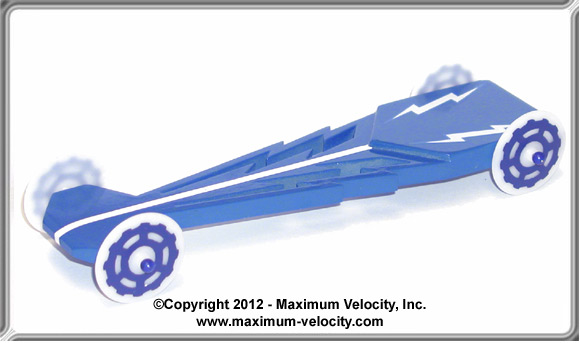
Lightning Bolt - Randy Davis

In 2012 we moved our local race from spring to the fall (two races this year), so I didn't have much time to work on a second car. Instead I used the photo model for the Lightning Bolt, which was a kit we sold for several years. I equipped the body with Needle Axle Wheels (white - a special order item), and our Needle Axle Upgrade Kit. The pattern on the sidewalls was cut out of sticky-back vinyl with a Cricut machine by my wife (thanks honey!). I'm sure the vinyl added a touch of weight, but it didn't matter as the car handily won the Outlaw race.

... and two cars from another entrant in the race.

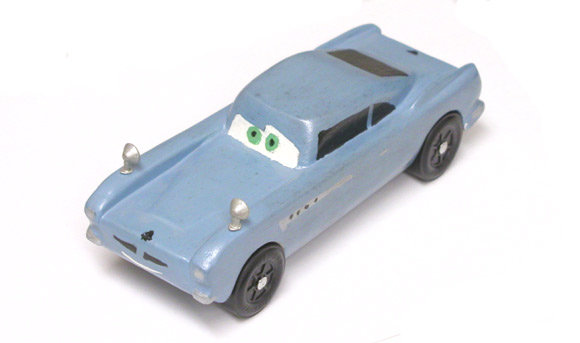
Finn McMissile - Richard Larson

In spring of 2012, Richard modeled Finn McMissile from the movie "Cars". The only non-wood parts are the dual mirrors, which came from a model car kit. Finn took first place in design.

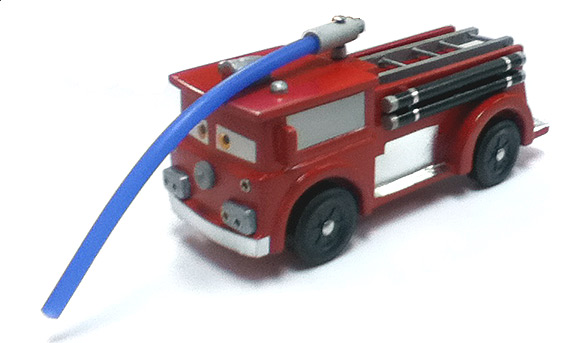
Red - Richard Larson

In the fall of 2012, Richard modeled the fire engine known as "Red" from the movie "Cars". Red weighs exactly 5 ounces, and actually has a small amount of ballast weight. The blue tubing represents a stream of water as Red is watering the flowers. It detaches for the actual race. Not surprisingly, Red took first place in design.

In 2011 Richard modeled 'Mater. You can see it in the Car Showcase Here.

Share Your Car With Our Readers

Do you have a car you would like to "show off" to our readers? If so, send us a photo of your car along with a brief description of any special features. Also, please include your full name. If selected, we will include the photo and description in this newsletter.Please e-mail photos to:
[email protected].

Photos must be sent by e-mail in JPG format (minimum size of 640x480, maximum size of 1280 x 960). Please shoot photos from the front left of the car, similar to the orientation of this car:


For better focus, keep the camera four or five feet away from the car, and then use the camera's zoom to fill the frame with the car.

Send only one photo per car, unless an additional photo is needed to adequately show a feature. Also, only one car per subscriber per year please. Thanks!


Q&A

Are BSA wheels now only made in China, or are there both Chinese and US wheels? The China-made wheels look a little weird - rougher in some respects.

My understanding is that Revell has a license from BSA to brand- label their products as official BSA. Revell offers BSA-replica wheels that are made in China. These are sold in many hobby and craft stores.

The wheels directly from BSA are US-made wheels. They are sold in scout shops and at Maximum Velocity.

All of the reports I have read indicate that the Revell wheels are inferior to the US-made BSA wheels.

Hello, my daughter has an Adventure Princess race this Saturday. We are using an Indy Products kit which contains two rod axles (instead of the traditional 4 nail-type single axles used in Boy Scouts). Should the rod axles be prepared in the same manner as nail axles? Should I add grooves to the rod axles? Are there any other key differences in car preparation to be aware of with respect to these Indy Products kits?

The same principles of preparation apply to the Indy Products kit as apply to a BSA kit. The issue you might encounter trying to groove the rod axles is that too much of the axle would extend out of the drill chuck, so the axle would flex or bend when trying to create the groove.

Make sure the retaining clips are smooth and the molding cut off locations are smooth - you don't want a sharp piece of plastic touching the wheel. Also, you will want to lube the inside of the clip (where it comes in contact with the wheel). A lot of energy can be lost in the plastic to plastic contact.

Do You Have Questions that Need Answers?
Do you have a pinewood derby-related question? If so, send your question to: [email protected]. We answer all questions by e-mail, but not every question will appear in the Q&A section of the newsletter.


Back Issues

Are you a new subscriber, or have you missed some of the previous newsletters? Don't miss out! All of the issues for Volume 5 through Volume 11 are posted on our web site and can be found using our Newsletter Index.

Issues from Volumes 1 to 4 are available in four formatted documents, ready for immediate download. To find out more, Click Here.


Newsletter Contributions

We welcome your contributions! If you would like to contribute an article, a web site review, or a speed tip, please send it to: [email protected].

Please read our submission policy.


Subscription Information

The Pinewood Derby Times is a free e-newsletter focused on the Pinewood Derby. It is published biweekly from October through March.

Please Forward This Issue to a Friend

If you haven't already done so, feel free to forward this issue to your pinewood derby friends. Thanks!

Sign Up

If this newsletter was forwarded to you, why not subscribe to receive this newsletter. It is absolutely FREE and your e-mail address is safe, as we never release our distribution list.

Please don't subscribe your friends. Let them decide for themselves. Thanks.

To subscribe, enter your e-mail address below and press 'Subscribe'. You will be sent a confirmation e-mail. Reply to the e-mail to complete the subscription.
Type Your E-mail Address


Randy Davis, Editor, Pinewood Derby Times
E-Mail: [email protected]

Copyright ©2012, Randy Davis. All rights reserved. Please do not reprint or place this newsletter on your web site without explicit permission. However, if you like this newsletter we grant permission, and encourage you to e-mail it to a friend.

The author disclaims any personal loss or liability caused by utilization of any information presented in this newsletter.

The Pinewood Derby Times is not specific to, and is not affiliated with the Boy Scouts, YMCA, Awana, or any other organization .

®Maximum Velocity! is a registered trademark of Maximum Velocity! Pinewood Derby Products.
Pinewood Derby, and Space Derby are registered trademarks of Boys Scouts of America. All other names are trademarks of their respective owners.

Mailing list services are provided by: www.mail-list.com